Mom, Let Me Show You: The Quiet Cultural Exchange Happening Between Immigrant Parents and Their American-Born Kids
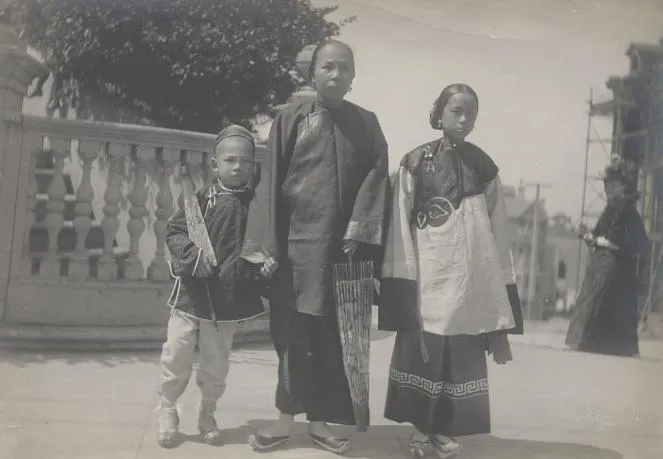
Photo: Unknown, Public domain, via Wikimedia Commons
It started, for Grace Yoon, with a farmers market.
Her mother, who had lived in suburban New Jersey for over twenty years and could navigate a Korean grocery store with military precision, had never once stepped inside the local Saturday market three blocks from their house. To her mom, it was just a place Americans went to buy expensive vegetables. To Grace, it was a ritual — iced coffee, sourdough samples, the particular pleasure of buying flowers you don't need.
"I basically dragged her," Grace laughs. "She kept asking why the tomatoes cost so much. But by the end, she was chatting with the woman who makes the honey and asking if she could get a discount for buying two jars."
That afternoon became a monthly thing. And then it became something more — a small but real bridge between two versions of American life that had existed, largely parallel, under the same roof for decades.
The Flip Side of the Family Translator
Anyone who grew up as the child of immigrants knows the weight of being the family's unofficial cultural interpreter. You translated documents, navigated phone calls, explained jokes that didn't land, and smoothed over misunderstandings between your parents and a world that didn't always make room for them.
But something shifts when those kids grow up. The dynamic doesn't disappear — it evolves. Suddenly, second-generation Korean and Asian Americans find themselves in a new role: not just translating language, but actively introducing their parents to aspects of American life that feel, finally, worth sharing.
This isn't about assimilation in the old, anxious sense. It's not about erasing where your family came from. It's something more nuanced — a kind of cultural generosity that flows in both directions, even if the direction has changed.
"I Made My Dad Download TikTok"
The stories are everywhere once you start looking for them.
David Kim, 28, spent three months teaching his father how to use Instagram Reels to promote his dry-cleaning business in Glendale, California. "He thought social media was for teenagers," David says. "Now he posts these little behind-the-scenes videos of him steaming suits and his engagement is genuinely better than mine."
Mia Tran, a 31-year-old graphic designer in Houston, introduced her Vietnamese-born mother to the local indie music scene after years of her mom dismissing anything that wasn't classic ballads. "I took her to this small venue in Montrose — like, a hundred people, a Korean American folk singer, candles on the tables. My mom cried. She said it reminded her of listening to music in Saigon when she was young. I did not see that coming."
And then there's the civic dimension, which might be the most significant of all. Adult children are increasingly serving as their parents' guides to local political life — not just translating ballots, but explaining why local elections matter, introducing them to community organizations, even bringing them to city council meetings.
"My parents voted in every presidential election but had no idea what a school board did," says Angela Park, a community organizer in the Chicago suburbs. "Once I explained it, my mom became obsessed. She's now on a first-name basis with our district's superintendent."
It Goes Both Ways (It Always Does)
Here's the thing nobody tells you about becoming your parent's cultural guide: you end up learning just as much as you teach.
When Grace started taking her mom to the farmers market, she expected to be the expert. What she didn't expect was her mom striking up a friendship with a Korean American vendor who made traditional rice cakes with local seasonal ingredients — a fusion that Grace's mom had strong opinions about, opinions she shared at length, opinions that led to a long conversation about what it means to adapt a recipe without losing its soul.
"She taught me more about Korean food culture in that conversation than I'd learned in my entire childhood," Grace says. "I was so busy being the guide that I forgot she knew things I didn't."
This is the texture of real intergenerational exchange — messy, nonlinear, occasionally frustrating, and quietly profound. The second-gen kid who introduces her mom to a podcast about American history ends up sitting through a three-hour explanation of why certain Korean historical dramas are more accurate than people think. The son who teaches his dad to use Yelp ends up learning which neighborhoods in their city have the best jjajangmyeon because his dad, newly empowered with review-reading skills, has done the research.
Rewriting the Script on "Americanization"
For a long time, Americanization was framed as something that happened to immigrant families — an outside force that gradually replaced one culture with another. The fear was always that kids would lose the language, the food, the values, and their parents would be left behind in the process.
What's actually happening in a lot of Korean and Asian American households looks different. It's less like replacement and more like expansion. Parents are adding new cultural fluencies without losing old ones. Kids are sharing parts of their American lives that they used to keep separate, maybe even hidden, from their parents.
"I used to have two completely different social lives," says one 33-year-old Korean American woman in New York. "My Korean life and my 'American' life. Now they're just... my life. And my parents are part of all of it."
The Art of Showing Up Together
There's something quietly radical about an immigrant parent and their adult child walking into a space together — a concert, a community meeting, a new restaurant — and both of them being a little unsure of what to expect. It levels something. It creates a shared vulnerability that years of the parent-as-authority, child-as-dependent dynamic can make hard to find.
These moments — small, ordinary, easily overlooked — are where a lot of the real cultural work happens. Not in grand gestures or formal programs, but in a mother asking her daughter to explain why everyone at the table ordered the same thing on Yelp, or a father letting his son show him how to find live music in a city he's lived in for thirty years without ever really exploring its stages.
It's not a perfect process. There are still misunderstandings, still moments where the gap feels too wide to cross. But there's also this: two people from different worlds, related by blood and complicated by culture, figuring out how to be curious about each other.
That's not a small thing. That might actually be everything.